

Prophets & Profits
Why The Simpsons predicted everything, and I predicted nothing

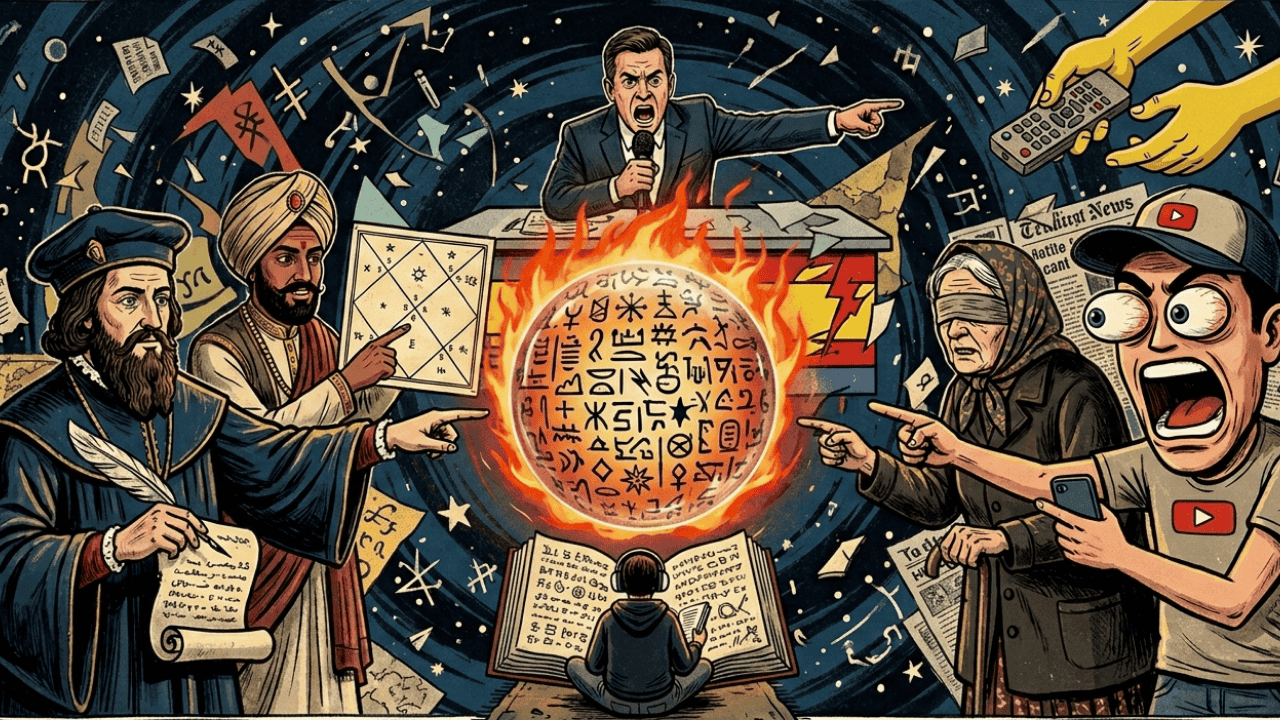
It is 2 AM. There is a war happening. And my YouTube feed has completely lost the plot.
Between the news alerts about missile strikes on Tehran, the algorithm has decided I urgently need to watch: “THE SOLAR ECLIPSE CONFIRMS IRAN WAR WAS INEVITABLE”, followed immediately by “Nostradamus 7-Month War Prophecy EXPOSED”, and then, because the universe has a sense of humour, “THE SIMPSONS PREDICTED THIS. WATCH BEFORE DELETED.”
I watch all of them. Obviously.
The astrology one features a man gesturing at a planetary chart with the focused energy of a cardiac surgeon. Red circles. Yellow arrows. A thumbnail of him looking directly into the camera with an expression that says: I have seen things. The voice-over explains that Mar’s current transit over Rahu in Aquarius, combined with solar and lunar eclipses, made the US-Israel-Iran conflict not merely likely but cosmically scheduled. Thousands of years of cosmic prophecy, finally vindicated. On YouTube. At 2 AM.
Baba Vanga, the blind Bulgarian mystic who died in 1996 and whose prophecies were, charmingly, never written down but passed along orally through generations, had apparently also predicted this. A war beginning in the East, spreading West. Her followers are having a very busy week.
Nostradamus, meanwhile, wrote a verse about “seven months of great war, people dead through evil” that is currently being applied to the situation with great confidence, despite the verse also mentioning Rouen and Évreux, two quiet towns in northern France that have no known involvement in Middle Eastern geopolitics.
And then there’s the news.
I want to be careful here, because the war itself is not a punchline. Real people are in genuine danger. The uncertainty is real. The stakes are real.
But the coverage — that’s something else entirely.
The studio sets look like war rooms. Dramatic red maps. Animated missile trajectories. Anchors speaking with the clipped urgency of people who have somewhere extremely important to be. Every thirty seconds, a new BREAKING banner slides across the screen, even when what follows is not, technically, breaking. I watched one channel run the ticker “SITUATION REMAINS TENSE” for forty-five uninterrupted minutes, which is perhaps the least informative sentence ever produced by a newsroom.
The green screens are spectacular. The facts are thinner.
What’s genuinely paradoxical about living now is this: if I actually want to understand what’s happening — the history, the geopolitical context, the honest assessment of what various parties want and why — I have to find a podcast made by an independent journalist at midnight, recorded in what sounds like a slightly echoey home office. The least produced content is the most informative. The most produced content is the most comforting. These are not the same thing, and we’ve quietly agreed to pretend they are.
But I digress. Back to The Simpsons.
Here is what you have to understand about The Simpsons’ gift for prophecy: it is genuinely, gobsmackingly impressive, right up until you do the maths.
Trump’s presidency: predicted. Disney buying Fox: predicted. The Titan submersible malfunction: predicted. Lady Gaga flying over the Super Bowl crowd on a harness: predicted. A Nobel Prize winner: predicted six years early. The mass of the Higgs boson, worked out in the background of a single throwaway joke — a physicist later confirmed Homer Simpson had it right.
I watched each of these revelations with the solemn, slightly spooked feeling of someone who has just been told their horoscope was accurate. They knew. How did they know?
Then I did the maths.
The Simpsons has produced over 800 episodes since 1989. Each episode is packed with jokes, predictions, throwaway gags, satirical projections, and background details. The writing staff, largely composed of people with degrees from Harvard, MIT, and similar institutions, spent decades mining contemporary culture, technology, politics, and human behaviour for material. They weren’t gazing into crystal balls. They were paying extremely close attention to the world and extrapolating, at high volume, for thirty-five years.
As one of their own writers put it: “If you throw enough darts, you’re going to get some bullseyes.”
The show has 805 episodes. Nobody makes compilation videos called “785 Times The Simpsons Were Completely Wrong.” But those videos would be much, much longer.
I know this about prediction because I am, personally, one of the worst practitioners in recorded history.
The startup I told three separate people would “definitely be bankrupt within a year” recently completed a funding round that valued it at slightly more than the GDP of a small island nation.
The relationship I was certain was the one — the kind of certainty that makes you want to tell strangers on trains — lasted three weeks before collapsing quietly under the weight of my own certainty.
I’ve never disliked a place I’ve visited. I find something in everything, everywhere. Which, as a writer, sounds like a gift. It’s also a curse because it means I’ve never once correctly predicted what a trip would feel like. I’d built elaborate internal films before every journey. The real place always showed up as something else entirely. Not worse. Just stubbornly, specifically itself.
There was a restaurant in Bengaluru that I told my friends to avoid. I was confident. The signage was bad. The menu description was worse. “It has the energy of a food poisoning waiting to happen,” I said, with genuine authority. It won a regional award four months later. I have not been back. Not out of principle, but I just can’t face it.
My predictions, in summary, are a disaster. And I have never once, upon being proven wrong, updated my confidence levels for the next prediction.
None of us do. This is the part they don’t put in the YouTube thumbnail.
Psychologists call it confirmation bias: we notice our hits and quietly file away our misses. The Simpsons gets celebrated for a few predictions while 785 episodes are peacefully forgotten. Nostradamus wrote 942 cryptic verses about war, pestilence, floods, and fire. The man essentially wrote 942 different ways to say “something bad might happen somewhere,” and we spotlight the handful that rhyme with current events while the rest collect dust.
Baba Vanga’s prophecies were never even written down. They exist as oral tradition, which means they are, functionally, a very long game of telephone with a dead mystic. And yet there are currently trending articles.
The friend who says, “I knew that would happen” after everything… you have one, we all have one… is not actually prescient. They’re just fast at retrofitting.
Here is what I’ve started to understand, after thirty-five years of being wrong about things and immediately forgetting that I was wrong: we are not prediction machines. We are story machines. We live through chaotic events, and afterward, we build a narrative in which the ending was always inevitable. Where a cartoon family, a French astrologer, a woman in Bulgaria, a man with a planetary chart, and a YouTube channel had seen it coming.
Because the alternative that things happen, often suddenly, without cosmic preview, is genuinely hard to sit with at 2 AM.
Which brings me to the profits.
The Prophecy Industrial Complex (the astrologers, the Nostradamus explainer channels, the Simpsons compilation editors, the Baba Vanga revival accounts) is not stupid. It is extremely good at its job. Its job is to sell certainty to frightened people, and frightened people are a growth market.
The news studios have figured out the same thing. Spectacle generates TRP. The feeling of being informed is more valuable, commercially, than actually being informed. So the sets get more dramatic. The tickers multiply. The experts get more confident, which is impressive given that they often confidently predict opposite things simultaneously, on the same channel, within the same hour.
Somewhere further down the supply chain, the defence industry is having a perfectly calm week. They don’t need prophecy. They plan. Budgets, contracts, inventory cycles, lobbying schedules. They are the only participants in this entire ecosystem who aren’t guessing, and they are making the least YouTube content.
Everyone else — us, the astrologers, the anchors, Nostradamus — is just trying to make sense of something that resists sense.
I closed the laptop around 3 AM. The war was still happening. The algorithm had queued up seventeen more videos. The astrologer had posted an update.
I thought about the restaurant in Bengaluru. The startup. All the times I’d looked at a situation and known, with total certainty, what would happen next.
I thought about the episodes of cartoon darts thrown at an infinite wall of possible futures.
I thought about a French astrologer writing vague verses about fire and destruction in 1555, and a content creator in 2026 nodding solemnly at his screen, going: yes, he saw this.
Here’s what I’ve accepted: I will never successfully predict anything. The next restaurant will surprise me. The next startup will humble me. The next trip will be nothing like the version I built in my head. The next war will arrive with its own specific logic that nobody’s planetary chart quite mapped.
But afterward? Afterward, I will absolutely have seen it coming.
I just want you to know: I predicted that too.
What’s the last thing you were completely certain about that turned out to be completely wrong?