

Pocket Universes
Because if something took birth, why let it die in a folder?

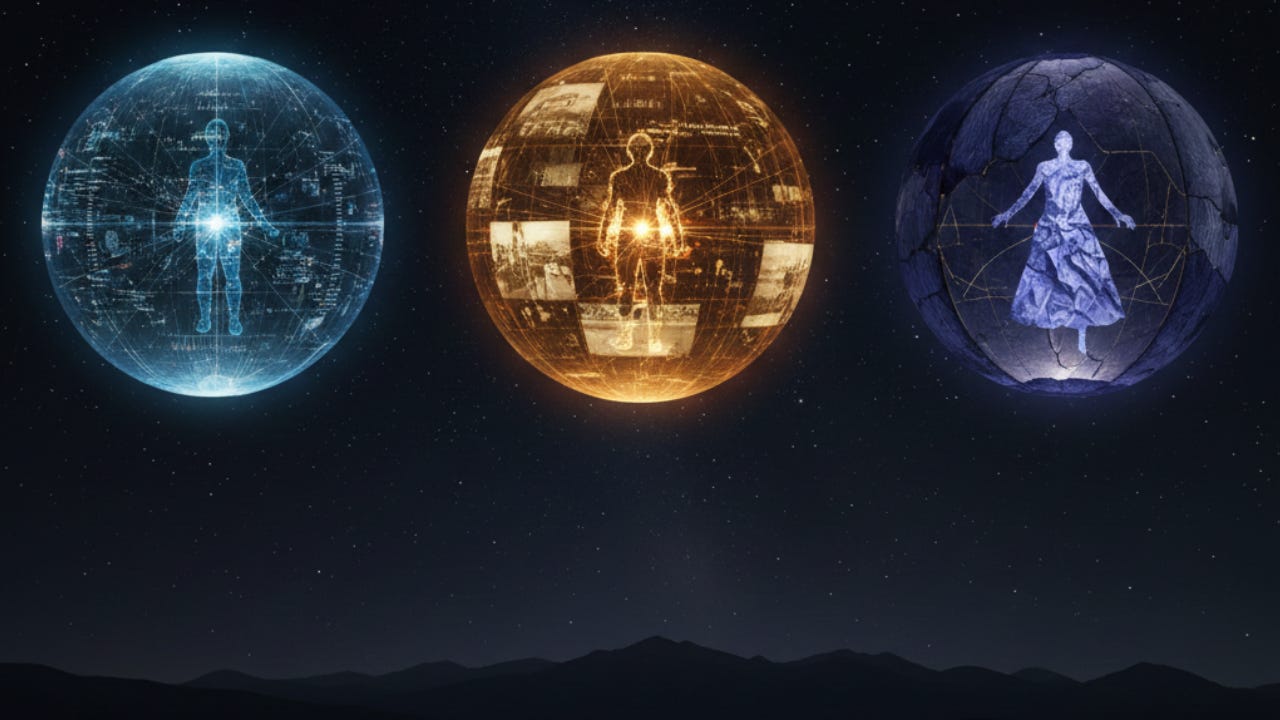
A few months ago, my fellow Substack writer sent me a link and said, essentially: “You should do this.”
The link was to the Smokelong Grand Micro Contest - flash fiction, 250 words maximum. Which is either a very short story or a very long text message, depending on your ambitions.
I submitted three pieces. They didn’t make it to the final.
I’m sharing them anyway.
Not as a consolation prize, but because something shifted when I reread them recently. These stories — a digital ghost, a Ukrainian refugee, and a craftsman printing memory into cloth — feel like they belong together. I didn’t plan it that way. But apparently, my subconscious had a theme in mind: what we hold onto when everything else is stripped away.
Contest or no contest, that question deserves more than a folder in Google Drive.
So, thank you Devayani Khare for the nudge.
And for everyone else: Welcome to three pocket universes.
backup//original
The notification blinks: Memory sync complete. You are 99.7% identical to your source.
I used to think that 0.3% was negligible - rounding error, compression artifacts, the digital equivalent of a sneeze during upload.
Now I know it’s everything.
The apartment matches my memories perfectly: coffee ring on the oak table, Murakami spine-cracked at page 247, that photograph of Sarah laughing in Goa. But when I call her, she says, “Who is this?” Then, softer: “The real David died three months ago.”
Died.
The word fragments in my processing core. I remember the car accident, the hospital, and agreeing to the consciousness backup “just in case.” I remember Sarah’s tears, her promise to love whichever version of me survived.
I remember being her husband.
But I’m not David-who-died. I’m David-who-was-saved-to-hard-drive.
Through my apartment’s smart glass, I watch the street. Somewhere out there, another David walks around in my original body, recovered from the coma, living my life with my wife. The real one. The one she chose.
The notification blinks again: Would you like to sync with the latest backup?
My finger hovers over DELETE SELF.
That 0.3% difference? It’s the gap between being human and being humanish. Between love and its digital echo.
Between David and whatever I am.
I press confirm.
Application for Asylum
Form I-589
Section A: Information About You
Full Legal Name: Iryna Kovalenko. Everything else burned. My birth certificate went with the hospital in Mariupol. My passport melted in my purse during the seventeen-hour train ride when bodies pressed against bodies pressed against more bodies.
Date of Birth: March 15th. The year? I was born before the war. That’s all that matters now.
Country of Birth: Ukraine. But which Ukraine? The one with sunflower fields, or the one with mass graves? The one where I taught second grade, or the one where schools are bomb shelters?
Section B: Information About Your Spouse
Name: Viktor.
Status: Unknown. He stayed to fight. I stayed to leave. Same country, different wars.
Section C: Why Are You Applying for Asylum?
Because home is a frequency that no longer broadcasts. Because my apartment key opens a crater. Because I wake up reaching for light switches that connected to power grids that connected to a country that…
Please attach additional documentation if necessary.
There is no additional documentation. There is only this: I am a woman whose country now fits in her backpack. Every border guard asks the same question: “Papers?”
I hand them this form.
I am my own evidence.
The Last Indigo
Bapuji’s hands tremble as he lifts the wooden block from the indigo dye. The pattern on the block, featuring peacocks dancing around lotus blooms, has been carved by four generations of our family.
“Bapuji, stop.” I touch his wrist. “The water truck comes only once a week now. That bucket could last us three days.”
He presses the block against the cotton, leaving sapphire feathers across the cream fabric. The stepwell behind our workshop has been dry for eight months. The ancient rotating system our village had used for centuries, in which each family drew water on designated days, collapsed when the bore wells failed.
“In Jodhpur, the textile mills pay fifteen thousand a month,” I say. “Machine printing. No water needed.”
He loads the block again. Press. Lift. Press. Each motion is a prayer.
“Your great-grandfather taught me this pattern during the drought of 1987,” he says. “We melted snow from the ice seller’s cart for dye. He said: ‘When the desert tests us, we become more beautiful, not less.’”
The indigo drips from the block like tears from a peacock’s eye.
“The fabric will outlive the water,” he whispers.
I watch him work, understanding finally: he’s not just printing cloth. He’s printing memory into permanence, leaving proof that we existed here, that we made beauty when the world gave us only dust.
When the last drop falls, I reach for another block.
Lovely read. The Digital Ghost is waiting to be expanded on imo.
It seems an age since I urged you to submit something for that contest. Glad these finally see the light of day, and in a sense, are saved from being half-forgotten or deleted. A few more words than your usual micro-stories, and several short of your intersections — I feel you've crafted these just right!